

The UGC Guidelines Quagmire: How Education Policy is Deepening India's Fault Lines

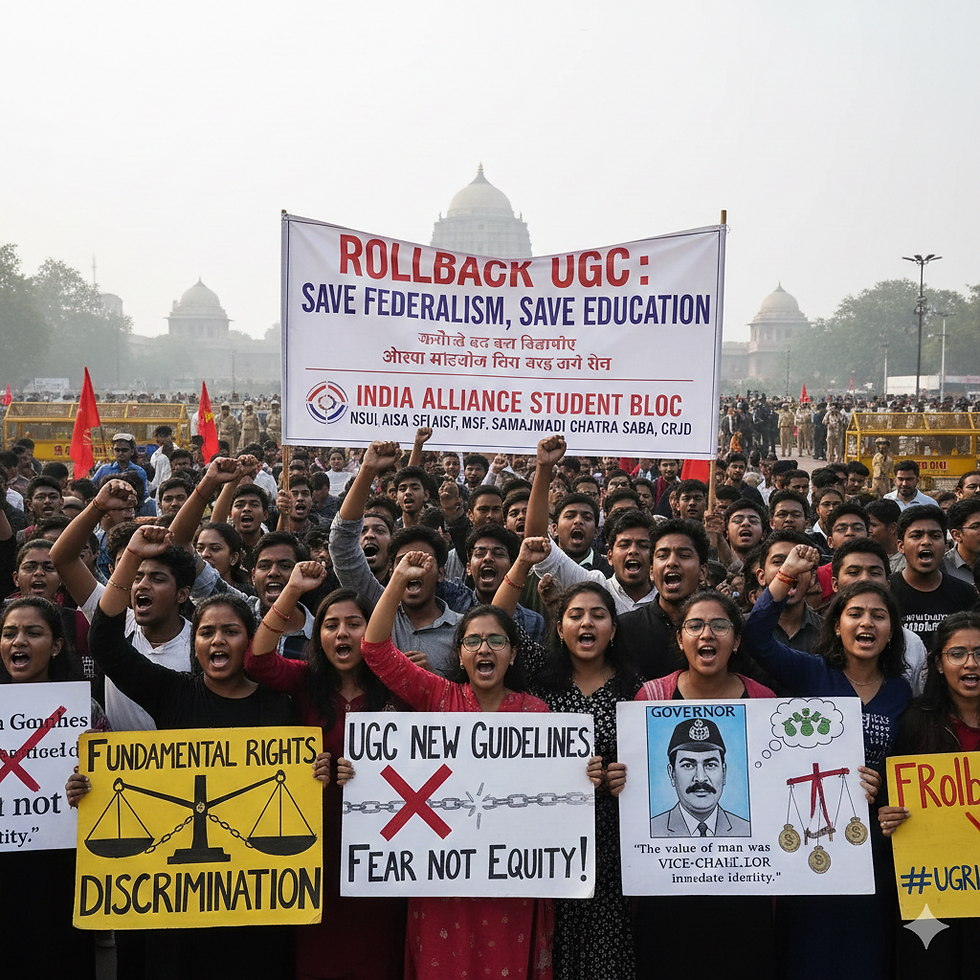
In the span of just seven days this January, the University Grants Commission unleashed a regulatory offensive that has triggered the most significant federalism crisis in Indian higher education since the Emergency-era transfer of education to the Concurrent List in 1976. The Draft UGC Regulations 2025 were released on January 6. The Promotion of Equity in Higher Education Institutions Regulations 2026, notified January 13, represent not administrative housekeeping but a calculated restructuring of power that has ignited campus protests, state rebellions, and fundamental questions about whether India's universities can survive as autonomous intellectual spaces or must become appendages of centralised political authority.The controversy has metastasised beyond policy disagreement into a constitutional crisis. Six states Kerala, Tamil Nadu, Karnataka, Himachal Pradesh, Jharkhand, and Telangana—adopted a 15-point resolution on February 6, 2025, demanding withdrawal of the Draft Regulations. By February 20, four southern states convened a National Convention in Thiruvananthapuram, passing resolutions and establishing plans for joint legal challenges. On March 24, student organisations affiliated with the INDIA block NSUI, AISA, SFI, AISF, MSF, Samajwadi Chhatra Sabha, and CRJD staged mass protests at Jantar Mantar demanding the rollback of both sets of regulations along with the National Education Policy 2020.Meanwhile, the #RollbackUGC and #UGCRollback hashtags have trended persistently on social media, with general category students expressing fears of becoming "perpetrators by birth" under equity regulations that define caste discrimination unidirectionally. The confluence of centralisation and caste-based regulatory architecture has created a perfect storm, one that reveals the Modi government's systematic strategy of fragmenting Indian society along multiple fault lines to advance an authoritarian vision of governance.The Draft UGC Regulations 2025 fundamentally transform the constitutional balance between the Centre and states in higher education governance. At its core lies a seemingly technical provision, Clause 10.1 on Vice-Chancellor appointments, that strips state governments of any meaningful role in selecting heads of state-funded universities.
The mechanism operates through three levers of centralisation:
First, the composition of search-cum-selection committees: Governors appointed by and answerable to the President (effectively the central government) gain unilateral authority to constitute three-member selection committees. The governor's nominee chairs the panel. The UGC chairman, himself a central government appointee, nominates the second member. The university's apex body (Senate/Syndicate) nominates the third. However, since governors increasingly invoke their authority to control university Senates and Syndicates in opposition-governed states, the "university representative" often reflects gubernatorial preference rather than institutional autonomy.State governments, despite bearing approximately 85 per cent of state university operational costs, are entirely excluded from this process. This represents a dramatic departure from previous practice, where state government nominees participated in selection committees through provisions defined in university-specific Acts.Second, eligibility expansion: The regulations permit individuals with "ten years of experience at a senior level in industry, public administration, public policy and/or public sector" to be appointed as Vice-Chancellors, even without academic credentials. The 2018 regulations required "a minimum of ten years' experience as a University Professor or in a reputed research and/or academic administrative organisation with proof of having demonstrated academic leadership."This dilution opens pathways for politically loyal administrators, industry representatives, or bureaucrats to occupy positions traditionally reserved for distinguished academics. As Professor Prabhat Patnaik, who led Kerala's five-member expert committee reviewing the regulations, observed: "The UGC is meant to function in consultation with universities, but in this case, it didn't even bother. It is supposed to focus solely on academic matters, yet it is now dictating the appointment of vice-chancellors."Third, tenure extension and coercive compliance: Vice-Chancellor tenures increase from three years to five years, creating longer periods of entrenchment for politically appointed leadership. Most critically, institutions failing to comply face de-recognition under Sections 2(f) and 12B of the UGC Act, effectively cutting them off from central funding and accreditation. This transforms what should be collaborative policy-making into command-and-control enforcement backed by institutional death penalties.
The State RebellionThe magnitude of state resistance is unprecedented. Six states initially adopted the February 6, 2025, joint resolution at the Conclave of State Higher Education Ministers in Bengaluru. The 15-point resolution characterises the regulations as "drastic, excessive, undemocratic" and accuses the Centre of imposing National Education Policy 2020 provisions through "dictatorial" punitive measures.Tamil Nadu emerged as the first frontline of resistance. On January 9, 2025, the Tamil Nadu Legislative Assembly passed a resolution against the regulations. Chief Minister M.K. Stalin wrote to Union Education Minister Dharmendra Pradhan demanding immediate withdrawal, arguing that "several provisions in the draft UGC regulations conflicted with the state's educational system and policies." Stalin simultaneously wrote to his counterparts in non-BJP-ruled states, urging them to pass similar resolutions: "We must stand united against these attempts to centralise power and undermine the federal structure of our country."Stalin specifically criticised the restriction on state government participation in Vice-Chancellor appointments, the mandatory entrance exams for undergraduate courses, and the proposed Multiple Entry Multiple Exit (MEME) system, which he argued would "destabilise universities by complicating academic planning and resource allocation." He also objected to allowing students with four-year undergraduate degrees in non-engineering disciplines to pursue M.Tech or M.E. courses without proper academic foundations.Kerala followed on January 21, 2025, with the Kerala Legislative Assembly unanimously adopting a resolution demanding withdrawal. Chief Minister Pinarayi Vijayan emphasised that "the power to establish and oversee universities lies with state governments, and the central government's role should be limited to coordination and standard-setting." The Kerala government appointed a five-member committee led by Professor Prabhat Patnaik to prepare a comprehensive document on the regulations' impact. The committee's report, released at the February 20 Thiruvananthapuram convention, concluded that the regulations "not only sideline the role of state governments, which contribute around 80 per cent of the funding for state universities, but they also undermine the democratic functioning of universities."
Karnataka Higher Education Minister M.C. Sudhakar credited Kerala for "spearheading the resistance against the UGC draft regulations and taking the debate to the national stage," while noting that "the UGC should have prioritised integrating the industrial sector with educational institutions instead of meddling with states' rights." Sudhakar clarified that Karnataka was not outrightly rejecting the regulations but that "certain provisions posed a serious threat to cooperative federalism."Telangana Deputy Chief Minister Mallu Bhatti Vikramarka participated in the February 20 National Convention, joining the unified southern state front demanding meaningful consultation with states.By February 20, 2025, the National Convention in Thiruvananthapuram marked the second coordinated conclave (following the February 6 Bengaluru meeting). States announced plans for a third conclave in Hyderabad and confirmed intentions to send a delegation to Prime Minister Narendra Modi and Education Minister Dharmendra Pradhan. Sources indicated that states had decided in principle to launch joint legal challenges, though Kerala government officials noted that "the absence of most vice-chancellors from state universities cast a shadow over the proceedings"an indication of gubernatorial pressure on university leadership to distance themselves from state government positions.The UGC extended the deadline for public feedback from February 5, 2025, to February 28, 2025, acknowledging the scale of opposition. However, UGC Chairman Professor Mamidala Jagadesh Kumar defended the regulations, claiming they "aim to ensure the highest standards in universities by introducing a more inclusive and transparent selection process" and "seek to uphold the autonomy and accountability of higher education institutions."
National Political Opposition
Leader of the Opposition Rahul Gandhi joined protests led by the DMK students' wing at Jantar Mantar in Delhi on February 6, 2025. Addressing the gathering, Gandhi characterised the regulations as "an attack on your history and culture" and criticised the RSS and BJP for "imposing a singular ideology on the country's education system." He specifically addressed Tamil Nadu students: "This is an attack on your language, your culture, your way of thinking."Samajwadi Party leader Akhilesh Yadav declared, "This New Education Policy is a conspiracy to hand over universities to industrialists. They want to take over all the power of the state governments. They want to make politicians servants of industrialists. We can never support the New Education Policy."Tamil Nadu Higher Education Minister Govi Chezhian accused the Centre of "using the new education policy as a tool to impose Hindi and Sanskrit," adding another linguistic and cultural dimension to federalism concerns.
Beyond the federalism crisis, the regulations systematically undermine academic standards through multiple mechanisms designed to privilege ideological alignment and industry connections over scholarly achievement.The regulations permit individuals with postgraduate degrees in one discipline to be directly recruited as assistant professors in "related disciplines." For appointments at all levels Assistant Professor, Associate Professor, or Professor candidates can possess PhDs in one subject while holding undergraduate or postgraduate degrees in completely different, unrelated disciplines. They can even pursue teaching careers in subjects they qualify for through entrance examinations such as UGC-NET, regardless of whether those subjects bear any relation to their prior academic training.
This represents a fundamental assault on the specialised knowledge that distinguishes genuine scholarship from superficial expertise. A candidate with a BA in History, MA in Sociology, and PhD in Political Science could, under these regulations, be appointed as Assistant Professor in Economics merely by clearing UGC-NET in Economics—without ever having pursued systematic undergraduate or graduate training in economic theory, econometrics, or quantitative methods.
Dr Maya John, a history professor at Jesus and Mary College, Delhi University, warned: "Many of the aforementioned parameters are difficult for applicants to attain at the entry level, especially with the proliferation of pay-by-hour guest lecturer appointments whose teaching experience is otherwise also not counted. These 'notable contributions' will prove particularly onerous for candidates from different regions, given the disparity in resources and uneven development of educational infrastructure in our country."
The "Notable Contributions" Regime
The regulations introduce nine categories of "notable contributions" required for recruitment and promotion: (1) Research in Indian Knowledge Systems, (2) Startup development aligned with institutional policy, (3) Fundraising and resource mobilization, (4) Lab development, (5) Online content creation, (6) Community service, (7) Linking with industry, (8) Consultancy services, and (9) Public administration experience.
Academic Council members of Delhi University expressed alarm that this shift represents "massive dilution in the quality of faculty, as well as would dilute the focus in cutting-edge research." The regulations remove the requirement for publications in UGC-CARE-listed journals previously the benchmark for academic quality replacing it with assessment by university-appointed committees. This creates opportunities for patronage-based appointments where loyalty to institutional leadership supersedes scholarly rigour.
Most troubling is the explicit prioritisation of "contributions to Indian Knowledge Systems" (IKS). While interdisciplinary engagement with India's intellectual traditions has value, IKS has increasingly become a euphemism for ideological gatekeeping. Faculty members in philosophy, literature, political science, and sociology may find themselves evaluated not on scholarly achievement but on alignment with particular interpretations of India's heritage—interpretations that privilege certain political and religious perspectives.
The regulations expect humanities teachers to "develop teaching labs, startup businesses, or funded consultancy skills," while science and mathematics faculty must "link all their courses to 'Indian knowledge systems.'" As one critique noted, this renders both requirements "farcical" humanities faculty are academics, not entrepreneurs, while forcing IKS frameworks onto quantum mechanics or differential calculus represents intellectual incoherence masquerading as cultural pride.
Professors of Practice: Administrative Control Over Academic Judgment
The elevation of "Professors of Practice"industrialists, bureaucrats, religious leaders, or administrators with "ten years of senior-level experience"to faculty positions fundamentally transforms universities from knowledge-seeking institutions into training grounds for corporate or political interests. As one analysis observed: "This effectively would transform the hitherto public-funded HEIs into bastions of corporate and industry-driven institutions with no regard for the common public good; allowing easier imposition of the agenda of the ruling government and outright political partisanship."
The "lateral entry" of non-academics belittles the acquired collective wisdom of the university community that pushes for sensitive, efficient and accountable administration." It signals that universities exist not to produce knowledge through critical inquiry but to serve immediate political and economic agendas defined by external stakeholders.
The Promotion Regime: Centralising Subjective Control
Previously, teachers became automatically eligible for promotion under the Career Advancement Scheme (CAS) based on objective criteria, including years of service, publications, and teaching evaluations. The new regulations replace this with mandatory fulfilment of the nine "notable contributions"assessed by centralised boards with subjective, interpretative authority.
This transformation concentrates power in administrative bodies to determine whether criteria have been "satisfactorily fulfilled," creating mechanisms for rewarding political loyalty and punishing intellectual independence. Teachers who critique government policy, support student movements, or publish scholarship inconvenient to ruling ideologies can be denied promotion through subjective assessment of their "notable contributions"even while maintaining exemplary teaching and publishing records.
The regulations maintain 100 per cent weightage for interviews in permanent recruitmenta measure that, as critics note, "has created the scope for all kinds of political cronyism and nepotism leading to mass displacements during permanent interviews held across Delhi University." By removing objective publication benchmarks while maintaining subjective interview dominance, the regulations create perfect conditions for patronage appointments.

THE EQUITY PARADOX: PROTECTION OR PERSECUTION?
If Draft Regulations 2025 centralise governance through administrative fiat, the Promotion of Equity in Higher Education Institutions Regulations 2026 pursue centralisation through caste-based surveillance and enforcement mechanisms that claim to combat discrimination while potentially institutionalising new hierarchies.
Genesis in Tragedy
The regulations emerged from Supreme Court petitions filed in 2019 by Radhika Vemula and Abeda Salim Tadvi, mothers of Rohith Vemula and Payal Tadvi. Their sons died by suicide Rohith on January 17, 2016, at Hyderabad Central University, and Payal on May 22, 2019, at BYL Nair Hospital, Mumbai following alleged caste-based harassment that university authorities failed to address.
Rohith Vemula's suicide note captured the psychological devastation of systemic exclusion: "The value of a man was reduced to his immediate identity and nearest possibility. To a vote. To a number. To a thing. Never was a man treated as a mind. As a glorious thing made up of star dust." His death exposed how institutional indifference to caste-based harassment creates conditions where brilliant minds are driven to self-destruction.
Payal Tadvi, a 26-year-old doctor, faced relentless casteist slurs and professional sabotage from senior resident doctors. Her mother's petition to the Supreme Court detailed how institutional complaint mechanisms failed, with administrators protecting perpetrators while victims suffered in isolation.
These tragedies exposed the inadequacy of existing 2012 UGC equity regulations, which lacked enforcement mechanisms and binding sanctions. Universities could ignore complaints, delay investigations indefinitely, and protect powerful faculty or senior students who engaged in caste-based harassment. UGC data submitted to the Supreme Court documented a 118.4 per cent increase in caste discrimination complaints between 2019-20 and 2023-24 rising from 173 cases to 378 cases, totalling over 1,160 complaints in five years.
This documented crisis demandeda robust response. The human cost extends beyond statistics to encompass systematic exclusion, derogatory comments, unfair evaluation, denial of research opportunities, and psychological torment that transforms universities from spaces of learning into sites of humiliation.
The Regulatory Framework
The 2026 regulations mandate a comprehensive institutional infrastructure for addressing caste-based discrimination:
Equal Opportunity Centres (EOCs): Every higher education institution must establish EOCs with full-time coordinators, support staff, and dedicated budgets. EOCs coordinate with civil society groups, police, district administration, legal services authorities, and media to facilitate comprehensive responses to discrimination.
Equity Committees: Institutions must constitute Equity Committees with mandatory representation from Scheduled Castes, Scheduled Tribes, Other Backward Classes, Persons with Disabilities, and women. Committees must meet within 24 hours of receiving complaints and submit investigation reports within 15 days.
Equity Squads: Mobile monitoring teams patrol campuses and "vulnerable spots" to prevent discrimination and harassment. The regulations empower these squads to intervene proactively in situations they identify as potentially discriminatory.
24/7 Helplines: Institutions must operate round-the-clock helplines for reporting discrimination, with protocols ensuring confidential complaint filing and immediate response.
Institutional Penalties: Universities failing to comply face potential de-recognition, loss of UGC funding, and regulatory sanctions creating powerful incentives for administrative compliance.The controversy centres on Regulation 2(c), which defines "caste-based discrimination": "discrimination only based on caste or tribe against the members of the scheduled castes, scheduled tribes, and other backward classes."
This formulation creates a unidirectional protection regime. Discrimination against general category students and faculty based on caste falls outside the regulatory definition of "caste-based discrimination," though it may theoretically be covered under broader "discrimination" provisions lacking the same enforcement mechanisms.The practical effect: if a professor makes casteist remarks against an SC student, it constitutes "caste-based discrimination", triggering the 15-day investigation timeline, Equity Committeeproceedings, and potential severe sanctions. If a professor makes casteist remarks against a general category student, it constitutes generic "discrimination" without the same urgency, dedicated committees, or enforcement apparatus.Critics argue this creates a legal framework wherein certain castes are categorically excluded from protection against caste-based discrimination—inverting rather than dismantling caste hierarchies. The #RollbackUGC campaign trending across social media crystallises general category students' fears of becoming "perpetrators by birth," subject to investigation by committees from which they are systematically excluded and vulnerable to complaints without safeguards against misuse.
The Safeguards Removed
Draft versions of the regulations included penalties for malicious or false complaints provisions removed from final regulations following criticism that they might deter genuine victims. However, their removal leaves no deterrent against the weaponisation of equity mechanisms for settling personal grievances, advancing careers through strategic allegations, or targeting individuals for ideological reasons.The absence of general category representation on Equity Committees compounds these concerns. A committee constituted entirely of SC/ST/OBC members however well-intentioned investigates complaints against general category students or faculty without built-in perspectives from the accused's community. This creates a structural imbalance: one group is subject to inquiry by a panel from which it is categorically excluded.The 15-day investigation timeline, while ensuring swift redressal for genuine complaints, allows minimal time for thorough investigation, due process protections, or consideration of complex interpersonal dynamics that might explain conflicts without resorting to caste-based discrimination frameworks.Combined with institutional penalties, including potential de-recognition for non-compliance, the framework creates immense pressure on administrators to accept complaints at face value rather than undertake rigorous inquiry that might find complaints unsubstantiated. The regulatory architecture thus incentivises administrative over-reach: better to sanction an innocent general category student than risk institutional penalties for inadequate response to discrimination complaints.
The regulations define discrimination broadly to include "implicit, indirect, or structural forms of unfair treatment." While such language captures subtle and systemic discriminationimportant given how caste discrimination often operates through unstated exclusions rather than explicit slurs it also creates ambiguity where "routine academic disagreements or social interactions" might be "misinterpreted as discriminatory acts."
A faculty member giving a lower grade to an SC/ST/OBC student might face discrimination complaints based on claims of bias, even if grades reflect legitimate academic evaluation. A general category student declining social invitation from SC/ST/OBC classmates might face complaints of exclusion, even if the refusal reflected personal circumstances unrelated to caste. Equity Squads patrolling "vulnerable spots" create surveillance infrastructure where normal campus interactions become subject to third-party interpretation and potential investigation.
The Comparative Framework
A table comparing 2012 regulations, 2025 draft regulations, and final 2026 regulations illuminates the evolution:
Feature | 2012 Regulations | 2025 Draft | 2026 Notified Regulations |
Scope of Protection | SC/ST only | Initially excluded OBCs | Explicitly includes OBCs alongside SC/ST |
Nature | Advisory, no enforcement | Transitional | Legally enforceable with institutional penalties |
False Complaints | No provision | Proposed penalties to discourage | Provision entirely dropped |
General Category Representation | Not specified | Not specified | No mandatory representation on Equity Committees |
Grievance Redressal | Relied on underperforming SC/ST cells | Proposed structured approach | Mandates time-bound EOCs, Committees, Squads, 24/7 helplines |
Investigation Timeline | Unspecified | Unspecified | 24-hour committee meeting, 15-day report submission |
Definition of Discrimination | Broad | Broad | "Only on the basis of caste" against SC/ST/OBC |
The evolution shows progressive strengthening of enforcement mechanisms alongside progressive narrowing of protected categories and progressive elimination of safeguards against misuse.Viewed comprehensively, these regulatory initiatives reveal systematic fragmentation of Indian society along multiple axes, creating divisions that prevent unified resistance to centralisation.
Federal Fragmentation
By empowering governors to override state governments in university governance, the Centre exploits political differences between state and central leadership. Opposition-governed states Kerala, Tamil Nadu, Karnataka, Telangana, Himachal Pradesh, Jharkhand—find themselves in prolonged conflicts with gubernatorial offices that function as central government proxies rather than constitutional heads maintaining federal balance.
The resulting battles already documented in the long-running Kerala-Governor Arif Mohammad Khan conflicts, Tamil Nadu's repeated clashes with governors over Vice-Chancellor appointments, and West Bengal's struggles with gubernatorial overreach—transform education from a collaborative national enterprise into a battlefield of political rivalry.
States bear 80-85 per cent of operational costs for state universities but lose governance authority. This represents taxation without representation in its contemporary form: states fund institutions they cannot control, while the Centre controls institutions it minimally funds. The constitutional placement of education in the Concurrent List was intended to enable national standards while respecting state diversity. The regulations effectively relocate education to the Central List through regulatory coercion, fundamentally undermining federalism.
Caste-Based Fragmentation
The Equity Regulations institutionalise caste-based divisions under the guise of protection. By defining certain castes as perpetual victims and implicitly designating others as potential perpetrators, the regulations reify the very caste consciousness constitutional values aim to transcend.The creation of "Equity Squads" patrolling campuses transforms educational institutions into surveillance states where students are categorised by caste identity rather than unified by shared pursuit of knowledge. Classrooms become sites of mutual suspicion: general category students fear false complaints, SC/ST/OBC students perceive resistance to equity mechanisms as evidence of upper-caste privilege, and faculty navigate conversations aware that any statement on caste-related topics might trigger complaints.This strategic fragmentation serves clear political purposes. Divided along caste lines, student communities cannot forge solidarity around shared academic interests, employment concerns, or resistance to administrative overreach. Campus politics fractures into identity-based factions rather than coalescing around universal student issues like fee structures, infrastructure quality, or democratic governance.The historical parallel to British colonial governance is instructive. Colonial administrators systematically exploited religious and communal differences to maintain control, implementing policies that privileged certain groups while disadvantaging others, creating mutual antagonism that prevented unified anti-colonial movements. The strategy culminated in Partition the permanent fracturing of the subcontinent along religious lines.Contemporary regulatory architecture replicates this divide-and-rule logic through caste rather than religion. By creating protection regimes that privilege certain castes while excluding others, by constituting enforcement bodies with mandatory caste-based composition, and by defining discrimination unidirectionally, the regulations ensure permanent caste-based divisions that prevent unified resistance to centralisation.
Ideological Fragmentation
The Draft Regulations' emphasis on "Indian Knowledge Systems," "Professors of Practice," and "notable contributions" defined by administrative committees creates ideological fragmentation. Faculty divided between those who align with approved IKS interpretations and those who maintain critical scholarly independence cannot present a unified defence of academic autonomy.Students indoctrinated in approved nationalist narratives, and those exposed to critical scholarly perspectives, develop incompatible worldviews, fragmenting student movements along ideological lines. The resulting campus environment mirrors national polarisation: every issue becomes an occasion for ideological warfare rather than reasoned debate.The regulatory offensive has triggered widespread campus unrest, with protests spanning student organisations, faculty associations, and political parties.
Student Organizations Mobilize
On March 24, 2025, student organisations affiliated with the INDIA bloc held massive protests at Jantar Mantar in Delhi. NSUI, AISA, SFI, AISF, MSF, Samajwadi Chhatra Sabha, and CRJD mobilised hundreds of students demanding the rollback of NEP 2020, the withdrawal of Draft UGC Regulations 2025, and the amendment of Equity Regulations 2026.
"We aim to draw the government's attention to education-related issues during the second leg of the budget session," an AISA-affiliated student told reporters. Protesters demanded free and fair student union elections in universities and colleges, filling of reserved category seats, continuation of scholarships, and restoration of academic autonomy.
The Students' Federation of India (SFI), founded in 1970 and claiming over a million members, has been at the forefront of resistance. SFI's 18th All India Conference, held June 27-30, 2025, in Kozhikode, Kerala, passed resolutions condemning both regulatory frameworks as assaults on federalism and academic freedom. SFI has historically mobilised against NEP 2020, fee hikes, and under-representation of reserved students in IITs, positioning itself as the primary left-progressive voice in Indian student politics.
The National Students' Union of India (NSUI), Congress party's student wing with over 4 million members across 15,000 colleges, has similarly mobilised nationwide protests. NSUI's manifestos for the September 2025 Delhi University Students' Union (DUSU) elections emphasised inclusive infrastructure, affordable education, rejection of NEP 2020, and increased public funding a direct rebuke to the regulatory architecture enabling privatisation and centralisation.
Faculty Resistance and Administrative Crackdowns
Academic Council members of Delhi University expressed grave concerns that the regulations would cause "massive dilution in the quality of faculty" and "dilute the focus in cutting-edge research." Professor Kaustav Banerjee of Ambedkar University Delhi's School of Global Affairs received a show-cause notice on March 28, 2025, for participating in protests against student suspensions, with the notice claiming his speech reflected "doubtful integrity" and was "against the interest of the institution."
Banerjee responded on April 1, 2025: "My speech was well within the rights of the freedom of expression guaranteed to me by the Constitution of India. Further, it is pertinent to note that freedom to freely engage in discussions on topics about unjust suppression, dissent, etc. are a sine qua non in maintaining the freedom of expression in our august university."
At IIT-BHU, students were deprived of hostel accommodation and library access for protesting over the alleged gangrape of an IIT-BHU student. At Tata Institute of Social Sciences (TISS), Dalit PhD student Ramdas Prinisivanandan was suspended in April 2025 for two years for participating in a protest in Delhi under the Progressive Student Forum banner. His activity was deemed "not in the interest of the nation." The Bombay High Court dismissed his petition in March 2026, and he has now moved to the Supreme Court.
Professor Apoorvanand of Delhi University was denied leave to attend the 20th anniversary celebrations of the India China Institute at The New School in New York from April 23 to May 1, 2025, after he refused to submit the text of his speech as demanded by the university administration. "A culture of fear has been established in universities in recent years. And vice-chancellors are seeing teachers and students as their enemies, for no real reason," he observed.
At South Asian University (SAU), four teachers were suspended in 2023 for "inciting and leading students" and "antisocial acts" by supporting protests against the reduction of monthly stipends. Ambedkar University Delhi sent emails to faculty on March 27, 2025, through the Dean of Academic Affairs, instructing them that it was "imperative" to report incidents where students were causing "disruption."
The Culture of Surveillance and Intimidation
The pattern is consistent across institutions: administrators, empowered by centralised control mechanisms and insulated from state government oversight, perceive dissent as a threat rather than democratic participation. Vice-Chancellors appointed through centralised processes and holding extended five-year terms owe primary allegiance to political masters rather than academic communities.
The resulting campus environment transforms universities from spaces of free inquiry into sites of surveillance, intimidation, and punitive discipline. Faculty self-censor to avoid show-cause notices. Students calculate whether participating in protests will jeopardise their academic careers through denial of hostel accommodation, library access, or recommendation letters. The chilling effect on intellectual life is profound.
As one academic noted: "Teachers will be recruited or rewarded not for imparting knowledge, but for mobilising finances and for being loyal to a particular political ideology." When loyalty supersedes scholarship as the criterion for advancement, universities cease functioning as knowledge-producing institutions and become indoctrination centres.
THE CONSTITUTIONAL CRISIS: FEDERALISM, EQUALITY, AND ACADEMIC FREEDOM
These developments strike at multiple constitutional foundations simultaneously.
Article 14 and Equal ProtectionThe Equity Regulations' unidirectional definition of caste-based discrimination raises serious equal protection concerns. Article 14 guarantees equality before the law and equal protection of laws to all persons. Courts have consistently held that classification must be reasonable, based on intelligible differentia, and bear a rational relation to the object sought to be achieved.While affirmative action provisions under Articles 15(4), 15(5), and 16(4) permit special measures for the advancement of SC/ST/OBC communities in educational institutions and public employment, these provisions authorise preferential treatment in admissions and appointments, not differential treatment in protection against discrimination.The argument that SC/ST/OBC communities experience disproportionate caste-based discrimination and therefore require special protection mechanisms has merit. However, the categorical exclusion of general category individuals from protection against caste-based discrimination rather than creating additional protections for SC/ST/OBC communities while maintaining universal protections may not survive constitutional scrutiny.A framework that defines caste-based discrimination to protect some castes while excluding others arguably violates the principle that anti-discrimination law should provide universal protection. The regulations could have mandated enhanced protections, expedited investigations, and severe penalties for discrimination against SC/ST/OBC students while maintaining that discrimination against any individual based on caste constitutes prohibited conduct. Instead, they created a hierarchy of protected classes precisely the caste-based stratification constitutional values reject.
The regulations' assault on academic autonomy implicates fundamental rights to practice any profession and conduct any occupation, trade, or business (Article 19(1)(g)), which courts have interpreted to encompass academic freedom. The Supreme Court has recognised that academic freedom includes the right of educational institutions to determine curriculum, select faculty based on merit, and govern academic affairs free from governmental interference beyond reasonable regulation.The centralised Vice-Chancellor appointment process, mandatory IKS integration, diluted qualification requirements, and subjective "notable contributions" assessment fundamentally compromise institutional autonomy. When non-academics can be appointed as Vice-Chancellors based on gubernatorial preference, when faculty promotions depend on administrative assessment of ideological alignment, and when universities face de-recognition for non-compliance with centrally mandated policies, academic freedom becomes illusory.
The constitutional placement of education in the Concurrent List (Entry 25, Seventh Schedule) reflects deliberate federal balance. While the Centre can legislate on matters of national importance, including coordination and determination of standards, states retain primary responsibility for establishing and governing universities within their territories.
The Draft Regulations exceed the Centre's coordinating role, effectively dictating university governance through coercive compliance mechanisms. The de-recognition penalty for non-compliance transforms regulatory guidance into mandatory commands, eliminating state flexibility to adapt governance structures to local conditions and preferences.
The Supreme Court's March 24, 2025, order establishing a National Task Force on student mental health and campus discrimination, headed by retired Justice S. Ravindra Bhat, acknowledges systemic failures. However, the Task Force's independent operation alongside regulatory implementation creates parallel tracks that may lack coordination. More fundamentally, the Task Force addresses symptoms (student mental health crises resulting from discrimination) without addressing structural causes (the undermining of institutional autonomy and due process protections that enable discrimination to flourish).
India's higher education crisis demands genuine reform rather than regulatory authoritarianism. Several principles should guide reconstruction:
Authentic Federalism
State governments must retain meaningful participation in university governance commensurate with their financial contributions and constitutional responsibilities. The appointment of Vice-Chancellors should involve state government nominees in selection committees, with governors facilitating rather than dominating the process. Search-cum-selection committees should include equal representation from: (1) state government, (2) central government/UGC, and (3) university academic community, with decisions requiring broad consensus rather than gubernatorial veto.The Concurrent List placement of education should be honoured through genuine consultation and collaborative policy-making. The Centre's role should focus on: establishing minimum standards, facilitating inter-state coordination, providing financial support for national priorities, and protecting fundamental rights not dictating governance structures or curriculum content.
Several states have called for education to be restored to the State List, giving states exclusive constitutional authority. While this would resolve centralisation concerns, it might fragment national education standards and impede student mobility. A middle path preserving Concurrent List placement while strengthening constitutional protections for state autonomy may be preferable.Anti-discrimination frameworks must protect all individuals regardless of caste background, recognising that prejudice and harassment can flow in multiple directions. The regulations should define caste-based discrimination as any adverse treatment based on caste identity, applicable to members of all castes. Enhanced protections, expedited procedures, and dedicated resources for SC/ST/OBC complaints can be maintained while ensuring that general category students who experience caste-based harassment have access to the same enforcement mechanisms.Equity Committees should include representative membership from all major caste groups, ensuring diverse perspectives in investigations. The principle should be that no group is investigated exclusively by committees from which it is categorically excluded. Safeguards against false complaints should be reinstated not to deter genuine victims but to prevent misuse and ensure due process.The investigation timeline should balance urgency with thoroughness. Fifteen days may be appropriate for clear-cut cases, but complex situations involving disputed facts, multiple witnesses, or ambiguous conduct may require extended investigation periods with transparent criteria for extensions. The goal should be accurate determination of facts and appropriate remedies, not administrative convenience or quotas for completed investigations.Faculty appointments and promotions should prioritise scholarly achievement and pedagogical excellence, assessed through transparent criteria emphasising publications in peer-reviewed journals, teaching evaluations, contribution to scholarly discourse, and mentorship of students. While interdisciplinary collaboration and practical experience have value, they cannot substitute for deep disciplinary expertise and demonstrated commitment to advancing knowledge.The UGC-CARE list or similar national journal quality standards should be restored, providing objective benchmarks for scholarly publication. University-appointed committees lack the specialised expertise and lack the institutional distance necessary to evaluate scholarship across disciplines fairly. National standards, developed through consultation with scholarly associations and subject experts, provide better protection against patronage appointments.
"Indian Knowledge Systems" should be approached as one valuable area of scholarshi among many, not as a mandatory ideological framework. Faculty pursuing research on Indian philosophical traditions, classical texts, or indigenous knowledge systems should be supported and valued. Faculty pursuing scholarship on global intellectual traditions, contemporary social problems, or theoretical frameworks originating outside India should be equally supported and valued. The measure should be scholarly rigour, notthe geographical origin of ideas."Professors of Practice" can enrich universities by bringing real-world expertise into classrooms, but should occupy specialised visiting positions rather than regular faculty appointments. Core faculty should possess terminal academic degrees in their disciplines and demonstrated records of scholarly contribution. Guest practitioners can deliver specialised courses, participate in practicum training, and mentor students on professional transitions without displacing academics in tenure-track positions.
University governance should be democratic, transparent, and accountable to academic communities rather than political authorities. Vice-Chancellors should be selected through broad consultation with faculty senates, student representatives, and alumni associations, with external members providing independent perspectives rather than political control.
Academic Councils should retain primary authority over curriculum, degree requirements, and academic policies. Administrative bodies should manage operations and finances, but not dictate intellectual content. Faculty should have meaningful voice in institutional governance through elected representation on key committees, protection from arbitrary discipline, and academic freedom to teach, research, and speak on matters of public concern without fear of retaliation.
Student unions should be democratically elected without administrative interference, with autonomy to advocate for student interests, organise protests against perceived injustices, and participate in university governance. The suppression of student unions has become increasingly common in recent years, destroying a critical democratic check on administrative power and depriving students of the training in democratic participation that universities should provide.Compliance requirements must be reasonable and proportionate, with institutional penalties reserved for systematic failures rather than deployed as coercive instruments to enforce political conformity. De-recognition should require demonstrated patterns of non-compliance, procedural safeguards including notice and hearing, and exhaustion of lesser remedies.The model should be collaborative improvement rather than punitive enforcement. When institutions struggle to meet standards, the response should be technical assistance, capacity building, and resource support, not threats of institutional destruction. The goal should be strengthening higher education, not creating compliant administrators who fear regulatory authorities more than they serve students.All regulations must align with constitutional principles of federalism, equality before law, academic freedom, and protection of fundamental rights—not merely claim alignment while systematically undermining these values. Independent constitutional review, either through pre-implementation assessment by law commissions or post-implementation judicial review through public interest litigation, should scrutinise whether regulatory frameworks respect constitutional boundaries.The Supreme Court's involvement through the National Task Force on student mental health and campus discrimination provides an entry point for broader constitutional examination. Public interest litigation challenging the regulations on federalism and equal protection grounds would enable judicial determination of constitutional validity rather than allowing implementation pending eventual challenge.The mothers of Rohith Vemula and Payal Tadvi approached the Supreme Court seeking accountability for their sons' deaths and mechanisms to prevent future tragedies. They deserved regulations that genuinely address caste discrimination's devastating psychological toll, protect vulnerable students from harassment, and ensure swift institutional response to complaints.Students navigating India's higher education system deserve institutions governed by merit and excellence rather than political patronage, where academic achievement determines advancement rather than ideological conformity, and where classroom discussions encourage critical inquiry rather than suppress dissent.States bearing primary financial responsibility for universities deserve governance authority commensurate with their constitutional role in higher education, meaningful participation in policymaking, and respect for regional diversity in educational approaches.
Faculty dedicated to advancing knowledge through scholarship and teaching deserve protection of academic freedom, transparent promotion criteria emphasising scholarly achievement, and institutional environments that reward intellectual contribution rather than political loyalty.Instead, they receive regulatory frameworks that centralise power while fragmenting society, institutionalise divisions while claiming to promote equity, and transform education, once conceived as the great equaliser and engine of social mobility, into yet another arena for political contestation and social fragmentation.The controversy has exposed fundamental questions about India's constitutional future. Can a federal democracy survive when the Centre systematically subordinates state governments through regulatory coercion? Can universities function as autonomous intellectual spaces when administrators owe primary allegiance to political masters rather than academic communities? Can caste equality be achieved through frameworks that privilege certain castes while excluding others from protection? Can scholarship flourish when promotion depends on ideological alignment rather than intellectual contribution?The answers will determine not merely the future of Indian higher education, but the future of Indian democracy itself. As protests mount, states organise legal challenges, and students trend hashtags, the Modi government faces a choice: retreat from regulatory authoritarianism and engage in genuine federal consultation, or proceed with implementation and face a prolonged constitutional crisis across multiple fronts.The choice reveals whether the government views education as a public good to be collaboratively nurtured or as an instrument of political control to be systematically captured. It reveals whether federalism remains a constitutional commitment or has become a procedural inconvenience to be evaded through regulatory creativity. It reveals whether caste equality means equal protection for all or perpetual hierarchies with reversed polarities.Most fundamentally, it reveals whether Indian democracy can accommodate diverse viewpoints, regional autonomy, and intellectual freedom or requires centralised uniformity, political conformity, and ideological discipline to survive.The six states that have united in opposition, the thousands of students who have protested, the faculty who have risked careers to speak, and the mothers who have channelled grief into advocacy all await an answer. The quality of that answer will define India's trajectory for generations to come.
sources @:This analysis draws on Supreme Court proceedings, state government resolutions, UGC notifications, party manifestos, academic scholarship, news reports, and documented student protests, examining the intersection of education policy, federalism, caste relations, and democratic governance in contemporary India.


Comments