

Marital Rape Criminalisation Bill Tabled in Parliament
- Sakshi Mishra
- Jul 6
- 9 min read

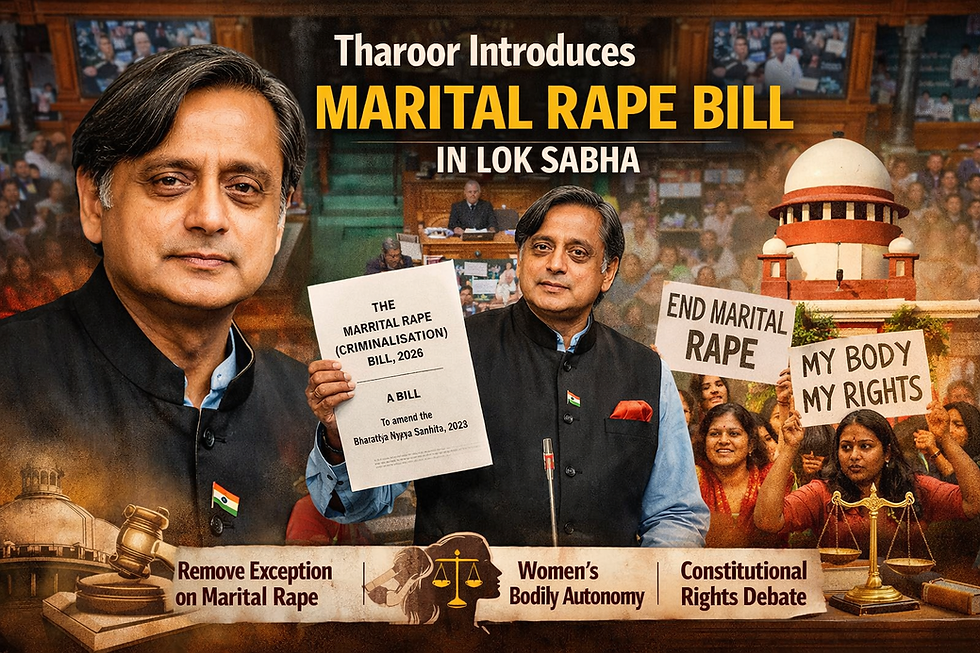
Congress Member of Parliament Shashi Tharoor on Friday introduced a Private Member's Bill in the Lok Sabha seeking to criminalise marital rape by amending Section 63 of the Bharatiya Nyaya Sanhita (BNS), 2023. The bill proposes to remove the marital rape exception that currently exempts husbands from prosecution for non-consensual sexual intercourse with their wives above 18 years of age, reigniting a contentious national debate on women's bodily autonomy, constitutional rights, and the sanctity of marriage. Addressing Parliament, Mr Tharoor, MP from Thiruvananthapuram, Kerala, asserted that India must transition from the principle of "no means no" to "only yes means yes," emphasising that marriage cannot override a woman's fundamental right to grant or deny consent. He described marital rape as fundamentally an act of violence rather than a matrimonial matter, arguing that every woman deserves bodily autonomy and dignity within marriage. The proposed amendment seeks to strike down Section 63 of the BNS, which currently permits non-consensual sexual intercourse by a husband with his wife, provided she is not under 18 years of age. This provision mirrors Exception 2 to Section 375 of the now-repealed Indian Penal Code (IPC), which exempted marital rape from criminal prosecution. In a statement released on social media platform X, Mr Tharoor wrote: "The criminalisation of marital rape is an urgent necessity in India's legal framework. India must uphold its constitutional values and move from 'No Means No' to 'Only Yes Means Yes.' Every woman deserves the fundamental right to bodily autonomy and dignity within marriage, protections that our legal system fails to provide. Marital rape is not about marriage but about violence. The moment for action has arrived."Mr Tharoor's bill draws extensively on constitutional principles and international legal standards. The primary arguments in favour of criminalising marital rape include:
Constitutional Violations: The bill argues that the marital rape exception violates Articles 14, 15, and 21 of the Indian Constitution. Article 14 guarantees equality before the law, yet the exception creates an arbitrary classification between married and unmarried women, denying married women equal protection from sexual violence. Article 15 prohibits discrimination on grounds of sex, while Article 21's guarantee of the Right to Life and Personal Liberty has been interpreted by the Supreme Court to encompass dignity, privacy, and bodily autonomy rights that are fundamentally violated when married women are denied control over their own bodies.
Justice Verma Committee Recommendations: The bill aligns with the landmark Justice Verma Committee Report of 2013, constituted following the December 2012 Delhi gang-rape incident. The Committee, chaired by Justice J.S. Verma (Retd.) and comprising Justice Leila Seth (Retd.) and Gopal Subramaniam, explicitly recommended the removal of the marital rape exception. The Committee observed: "The exemption for marital rape stems from a long, outdated notion of marriage which regarded wives as no more than the property of their husbands. Marriage should not be considered as an irrevocable consent to sexual acts. A marital or other relationship between the perpetrator and victim is not a valid defence against the crimes of sexual violence."
International Legal Obligations: India is a signatory to the Convention on the Elimination of All Forms of Discrimination Against Women (CEDAW), which calls for broader definitions of rape to include marital rape. Article 253 of the Constitution empowers Parliament to legislate in alignment with international conventions, while Article 51 enjoins the State to respect international law. According to United Nations data, approximately 77 out of 185 countries have explicit laws criminalising marital rape, while 74 countries permit women to file complaints against their husbands for sexual violence.
Colonial Legacy: The marital rape exception is rooted in the archaic Doctrine of Coverture from Anglo-American common law, which held that upon marriage, a woman's legal identity merged with her husband's, rendering her property of her spouse. This Victorian-era concept, transplanted to India during British colonial rule in the 1860 IPC, is fundamentally inconsistent with modern constitutional values recognising women as independent legal entities with full rights.
Opponents of criminalising marital rape, including various civil society groups and some legal experts, present several counterarguments:
Preservation of Marriage Institution: Critics argue that criminalising marital rape could destabilise the institution of marriage, which is considered sacred in Indian society and forms the foundation of family structures. They contend that the State has a legitimate interest in preserving marital stability and that introducing criminal liability for non-consensual sex within marriage could lead to increased marital discord and family breakdown.
Potential for Misuse: A significant concern raised is the possibility of false accusations. Given existing provisions like Section 498A IPC (cruelty) and the Protection of Women from Domestic Violence Act (PWDVA), 2005, which some argue have been misused to harass husbands and their families, opponents fear that criminalising marital rape would provide another tool for vexatious litigation. They emphasise the difficulty in proving consent within marital relationships and the potential for abuse of such legislation.
Existing Legal Remedies: Opponents point to existing civil and criminal remedies available to married women facing sexual abuse, including the PWDVA, 2005, which recognises sexual abuse as a form of domestic violence (though it provides only civil remedies), and Section 498A IPC for cruelty. Section 376B IPC already criminalises non-consensual sex by a husband with a wife living separately, albeit with lesser penalties (two to seven years) compared to rape outside marriage (minimum ten years).
Legislative Prerogative: Some legal scholars argue that determining the contours of marital relationships falls within the legislative domain, requiring careful consideration of India's unique social, cultural, and religious fabric. They contend that courts should exercise judicial restraint and defer to Parliamentary wisdom on such sensitive socio-legal matters.
The urgency of addressing marital rape is underscored by disturbing data from the National Family Health Survey-5 (NFHS-5), conducted between 2019 and 2021. The survey, which covered 636,699 households, 724,115 women, and 101,839 men across all 28 states and 8 union territories, revealed:
Prevalence of Spousal Violence: According to NFHS-5, 83 per cent of women aged 18-49 who experienced sexual violence identified their current husband as the perpetrator. This statistic represents an overwhelming majority, highlighting the pervasive nature of sexual violence within marriages.
Overall Domestic Violence: Approximately 29.3 per cent of all married women aged 18-49 years (nearly one in three) have experienced spousal violence at least once, including physical, sexual, or emotional abuse. This figure has marginally decreased from 31.2 per cent reported in NFHS-4 (2015-16) and 37 per cent in NFHS-3 (2005-06), yet remains dangerously high.
Sexual Violence Statistics: Research based on NFHS-5 data indicates that approximately 6.1 per cent of married women reported experiencing sexual violence in their lifetime, though experts believe this figure significantly underrepresents actual prevalence due to underreporting caused by social stigma, fear of family disruption, and lack of legal recognition.
Physical Injuries: Among married women aged 18-49 who experienced spousal physical or sexual violence, 25 per cent reported physical injuries, including 7 per cent with eye injuries, sprains, dislocations, or burns, and 6 per cent with deep wounds or broken bones.
Help-Seeking Behaviour: Alarmingly, only 14 per cent of women subjected to violence by their husbands seek external assistance, a decrease from 24 per cent in the previous survey, indicating pervasive silence around domestic sexual violence.
The absence of a specific law criminalising marital rape creates substantial obstacles for women seeking justice. Currently, married women who experience non-consensual sexual intercourse by their husbands cannot register criminal complaints for rape under Section 63 BNS or the former Section 375 IPC. This legal lacuna means:
No Criminal Redress: Women cannot file First Information Reports (FIRs) specifically for marital rape, as the act is not recognised as a criminal offence. This effectively renders married women legally defenceless against sexual violence perpetrated by their spouses.
Limited Civil Remedies: The PWDVA, 2005, provides civil remedies including protection orders, residence orders, monetary relief, and custody orders, but does not result in criminal conviction or imprisonment of the perpetrator. Many activists argue that civil remedies are insufficient deterrents for sexual violence.
Underreporting and Normalisation: The lack of legal recognition contributes to the normalisation of marital rape, with many women unaware that non-consensual sex within marriage constitutes sexual violence. Cultural attitudes that view wives as obligated to submit to their husbands' sexual demands further compound this issue.
Data Gap: Because marital rape cases cannot be registered as distinct criminal offences, accurate data on the prevalence of marital rape remains unavailable, hampering evidence-based policy formulation and intervention strategies.
The constitutional validity of the marital rape exception has been subject to extensive judicial scrutiny, most notably in the RIT Foundation v. Union of India case before the Delhi High Court. On May 11, 2022, a Division Bench comprising Justice Rajiv Shakdher and Justice C. Hari Shankar delivered a split verdict that exemplified the deeply divided national sentiment on this issue.
Justice Shakdher's Opinion: Justice Shakdher struck down Exception 2 to Section 375 IPC as unconstitutional, holding that it violated Articles 14, 15, and 21 of the Constitution. He observed that the classification based on marital status was manifestly arbitrary and discriminatory, treating forced sex within marriage as anything but rape while recognising the same act outside marriage as a serious crime. Justice Shakdher emphasised: "When marriage is tyranny, the State cannot have a legitimate interest in saving it. Allowing a husband to force sex upon his wife disregards her autonomy and perpetuates a culture of control and gender-based violence."
He rejected the argument that courts must defer to legislative policy choices in such matters, asserting that the judiciary's constitutional duty is to safeguard fundamental rights, not shield regressive laws from scrutiny. Justice Shakdher invoked Article 13, which declares void any law violating Part III (Fundamental Rights) of the Constitution.
Justice Hari Shankar's Dissent: Justice Hari Shankar upheld the constitutionality of the marital rape exception, asserting that the classification between marital and non-marital relationships was based on intelligible differentia with rational nexus to the legislative objective. He held that marriage creates a legitimate expectation of sexual relations, whether consensual or non-consensual, and that criminalising marital rape falls within the legislative domain, requiring consideration of social and cultural factors.
Justice Shankar argued that the impugned exception does not condone forced sexual intercourse by husbands but merely refrains from labelling it as "rape." He noted that other legal remedies exist for aggrieved wives, including Sections 304B (dowry death), 306 (abetment of suicide), 377 (unnatural offences), and 498A (cruelty) of the IPC, as well as divorce on grounds of cruelty.
The split verdict resulted in both judges granting a certificate of leave to appeal to the Supreme Court, where multiple petitions challenging the marital rape exception now remain pending. India is among approximately 34 countries that have not criminalised marital rape, placing it in the company of developing nations,s including Pakistan, Bangladesh, China, Myanmar, Sri Lanka, Afghanistan, Saudi Arabia, Haiti, Laos, Mali, Senegal, Tajikistan, and Botswana, according to UN Women reports. Conversely, approximately 150 countries have criminalised marital rape as of 2019, with many doing so relatively recently. The United Kingdom abolished the marital rape exemption through the landmark case R v. R in 1991. Poland criminalised marital rape in 1932, and the Soviet Union in 1922, making them among the first nations to do so. Countries including the United States, Canada, South Africa, Australia, and most European nations now treat marital rape with the same severity as rape outside marriage. The Union government has consistently opposed criminalising marital rape. In an October 2024 affidavit filed before the Supreme Court, the Ministry of Home Affairs argued that labelling non-consensual sex within marriage as "rape" would be "excessively harsh" and could destabilise the institution of marriage. The 49-page affidavit marked the first comprehensive articulation of the government's opposition to removing the exception. In 2017, the government had similarly contended that criminalising marital rape could become "a phenomenon that may destabilise the institution of marriage and an easy tool for harassing husbands." A Parliamentary panel examining the Criminal Law (Amendment) Ordinance in 2013 had observed that "the entire family system will be under great stress" if marital rape were criminalised, leading to the Justice Verma Committee's recommendation on this issue being excluded from the Criminal Law (Amendment) Act, 2013. Recent High Court decisions have further complicated the legal landscape. The Chhattisgarh High Court ruled that Section 377 IPC (criminalising unnatural sex) does not apply to non-consensual unnatural acts within marriage, effectively extending marital rape immunity to such acts. The Madhya Pradesh High Court similarly observed that consent is immaterial in marital sexual acts, limiting legal recourse for married women subjected to various forms of sexual violence. As a Private Member's Bill, Mr Tharoor's proposal faces substantial procedural and political hurdles. Historically, very few Private Members' Bills pass into law, as they require substantial Parliamentary support and government backing. Most such bills are either withdrawn after a government response or defeated in a vote.
Nevertheless, the introduction of this bill serves several important functions:
Parliamentary Debate: It compels sustained debate on a critical women's rights issue, potentially shifting public and political discourse.
Judicial Influence: Legislative debates can influence pending Supreme Court proceedings on the constitutional validity of the marital rape exception.
International Pressure: Parliamentary discussion highlights India's non-compliance with international human rights obligations, potentially increasing pressure for reform.
Social Awareness: Public discourse generated by the bill increases awareness about marital rape and women's bodily autonomy, challenging entrenched patriarchal attitudes.
Conclusion
The marital rape debate encapsulates India's broader struggle between constitutional ideals of equality and dignity versus deeply embedded patriarchal norms that subordinate women's autonomy to marital obligations. Mr Tharoor's bill represents an attempt to align Indian law with constitutional principles and international human rights standards, recognising that forced sexual intercourse constitutes violence regardless of marital status.
As the Supreme Court continues deliberations on the constitutional challenge to the marital rape exception, and as Parliament considers Mr Tharoor's bill, India stands at a critical juncture. The decision will determine whether the nation chooses to uphold bodily autonomy and gender equality or continue privileging institutional preservation over individual rights, a choice that will profoundly impact the lives of millions of married women across the country. The statistics are stark, the constitutional arguments compelling, and the international consensus clear. Whether India's legal system will finally recognise that consent matters equally within and outside marriage remains to be seen. Still, the introduction of this bill ensures that the question can no longer be ignored.
Mr Tharoor also introduced two additional Private Member's Bills on Friday: one seeking to amend the Occupational Safety, Health and Working Conditions Code, 2020, to establish a "Right to Disconnect" for employees, and another proposing the establishment of a State and Union Territories Reorganisation Commission to recommend future reorganisation of states and Union territories based on data-driven analysis.


Comments