
Dargah Drama? SC Says Not Our Case
- Sakshi Mishra
- Feb 4
- 6 min read

New Delhi | Supreme Court Desk
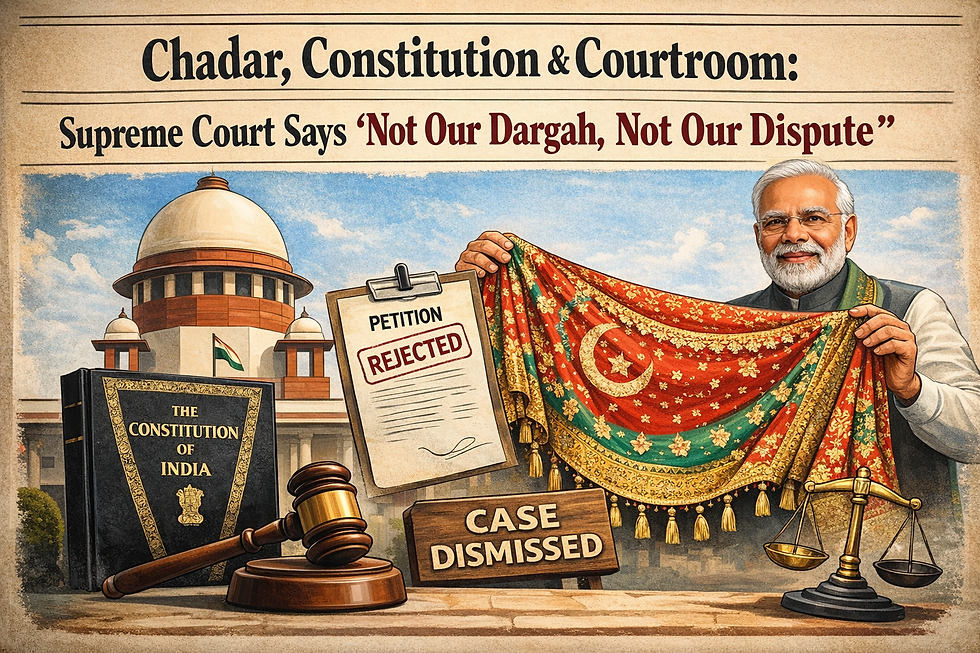
In Court No. 1, where issues related to the constitution commonly influence the decisions of the government, faith attempted to enter the witness stand, but the law decisively directed it back out. On Friday, the Supreme Court of India rejected a request aimed at preventing Prime Minister Narendra Modi from presenting a ceremonial chadar at the renowned Ajmer Sharif Dargah located in Rajasthan.
The individual who filed the petition sought to reinterpret a long-standing religious tradition as a breach of constitutional law, claiming that the Prime Minister's action blurred the division between religion and government. However, the Bench remained unswayed. Describing the request as “not justiciable” and “unproductive,” the Court clearly distinguished between issues of personal belief and legally enforceable rights, emphasising that its authority is connected to the law rather than religious practices.
In a few concise statements, the judges redefined what was presented as a potential conflict between secularism and symbolism into a non-issue. The implication was clear: constitutional courts are not venues for regulating ritual or religious practices, even if the individual involved is the country's leader. In this legal drama, the true champion was the principle of separation between religion and judicial review, which subtly triumphed.
A Legacy of Symbolic Outreach Prime Minister Narendra Modi, adhering to a tradition followed by various Indian officials across different political parties, dispatched a ceremonial chadar to be presented at the Ajmer Sharif Dargah in Rajasthan. This offering, made during the Urs festival honoring the Sufi saint Khwaja Moinuddin Chishti, is commonly regarded as a symbolic act of goodwill, symbolizing a blended culture and showcasing communal unity.
The Gesture Enters the Courtroom. What started as a routine gesture of state connection to a respected Sufi shrine unexpectedly came under legal examination. A public interest lawsuit questioned whether the Prime Minister, representing a secular administration, could be involved in a specific religious ceremony, suggesting a violation of the constitutional boundary separating the State from religion.
From Symbolism to Constitutional Scrutiny. By prompting judicial involvement in what has usually been considered a ceremonial and symbolic action, the petition aimed to shift a cultural and political practice into a constitutional dispute. It raised a more pointed inquiry: where does acceptable symbolism conclude, and where might a constitutional violation begin? Consequently, the case was prepared for a legal assessment of the boundaries of secular governance in public religious expressions by high-ranking constitutional officials.
In early January 2026, shortly before the annual Urs festivities at Ajmer Sharif, the Supreme Court of India in New Delhi briefly became a battleground between ritual symbolism and constitutional values. A public interest petition brought the Prime Minister’s established practice of sending a ceremonial chadar to the dargah into the courtroom, arguing that a constitutional figure should not appear to engage in a particular religious tradition. By characterising the offering as a possible infringement on the secular nature of the State, the petition encouraged the Court to examine whether such symbolic actions by the head of government could withstand constitutional scrutiny, thus turning a conventional gesture of goodwill into a significant exploration of the boundaries of secular governance and the appropriate separation between governmental authority and religious practice.
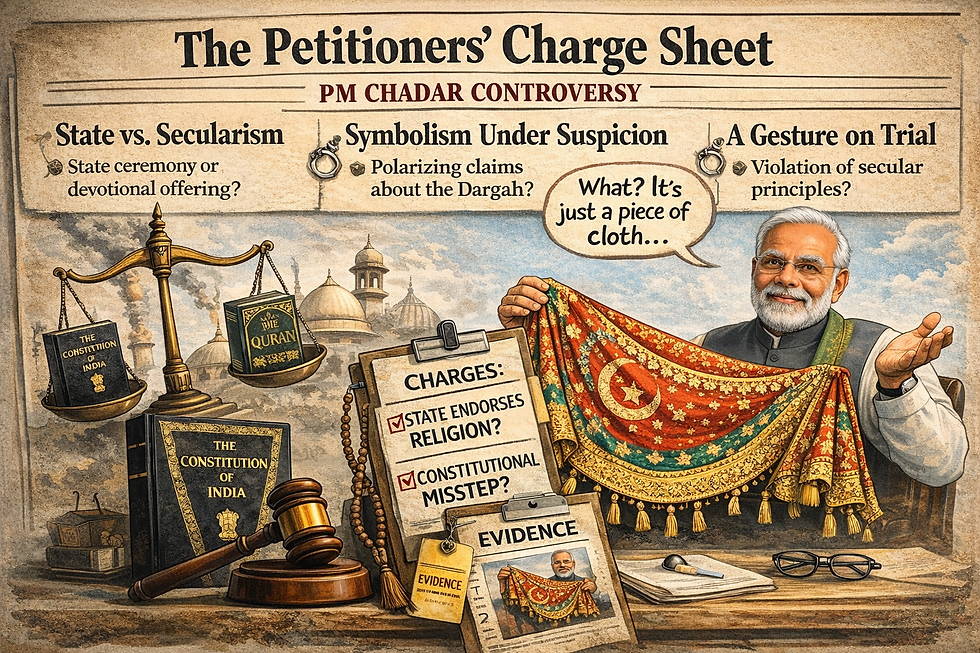
The Petitioners’ Charge Sheet
In front of the Supreme Court, the petitioner characterised the Prime Minister's offering of a chadar not as a harmless custom but as a violation of constitutional principles. Central to the challenge was a straightforward yet significant argument: when the leader of the government openly connects himself with a religious activity, the government might be seen as endorsing that particular faith.
State vs. Secularism
The petition contended that the Prime Minister presenting a chadar is not merely a personal act of devotion but a case of governmental involvement in a religious event, particularly when performed officially and extensively publicised. This, the petitioner asserted, contravenes the fundamental structure doctrine of the Constitution, wherein secularism is seen as an essential aspect. They believed that the act blurred the distinction between governmental neutrality and religious endorsement, amounting to “excessive devotion, insufficient constitutional separation.”
Symbolism under Suspicion
With a more acute focus, some extremist groups sought to take advantage of the dispute by resurrecting historical and communal narratives concerning the Dargah location. Although lacking legal strength, these claims introduced a divisive storyline into what had previously been regarded as a symbolic gesture toward community unity. Thus, the petition aimed to redefine a traditional offering as a constitutional issue, claiming that the chadar had transformed into “a piece of fabric filled with legal entanglements.”
A Gesture on Trial
Ultimately, the petition urged the Court to determine whether high-ranking constitutional officials can participate in religious practices in public without breaching secular principles. Or, in more lighthearted terms, could the Prime Minister extend goodwill without causing a crisis of identity for the Constitution?
The Supreme Court put an end to the debate by firmly rejecting the request, indicating clearly that not every political uproar can be treated as a matter for the courts to resolve. While convened in New Delhi, the panel determined that the challenge regarding the Prime Minister's offering of the chadar was “not justiciable,” meaning it did not reveal any legal wrongdoing appropriate for court examination. The justices also pointed out that, in any case, the issue had become moot since the ceremonial event had already taken place. Emphasising the constraints of judicial authority, the Court remarked that constitutional courts are not responsible for overseeing ceremonial practices or judging symbolic politics, but are institutions intended to resolve tangible rights and enforceable duties. In practical terms, the ruling indicated that no actionable legal harm had been established; essentially, the petition showcased a disagreement of a political and ideological nature, rather than a breach of constitutional law. To put the Court’s viewpoint simply: this was not a matter involving a constitutional injury, but rather a situation where certain feelings were unsettled, representing a "political challenge" rather than a legal issue. By reinforcing the limits of judicial examination, the stance arising from the case highlights that no law in India forbids elected officials from engaging in religious or cultural practices within their personal or ceremonial roles. Such involvement, standing alone, does not automatically equate to a constitutional violation. As long as these actions remain symbolic and lack definite legal outcomes, with no rights infringed or benefits altered based on religious criteria, they typically do not merit the Court's oversight through judicial review. This perspective aligns with India’s framework of affirmative secularism, which does not necessitate that the State maintain a hands-off approach to religion, but instead requires equal regard and principled neutrality towards all belief systems. Legally speaking, the simple appearance of a public official being associated with a religious or cultural event, in the absence of clear evidence of discrimination, coercion, or state favouritism toward one religion, does not represent a constitutional infraction; it is situated in the sphere of politics and symbolism and does not belong to the area of enforceable constitutional damage.

This episode exemplifies how politically symbolic actions can quickly escalate into significant legal battles, even when they awkwardly fit within the established frameworks of Article 32 and Article 226 jurisdiction. By opting not to engage, the Court established a clearer distinction between authentic constitutional breaches that affect fundamental rights or the core structure and mere clashes of public opinion or political perception. The essential point conveyed is that the writ remedy is intended to address enforceable legal harm, not all instances of ideological unease or partisan discord. In doing so, the Court reiterated that its constitutional duty is to protect rights and maintain the constitutional framework, rather than to oversee symbolic acts or performative politics. In other terms, while individuals can feel offended, not all disputes transform into legitimate grounds for constitutional lawsuits; some disagreements warrant a collective pause instead of a writ petition within the realm of democratic debate.
As clarity emerged, the Supreme Court made its stance on its jurisdiction quite evident: not every chadar necessitates a ruling, and not every custom deserves a legal examination. By choosing not to escalate a ceremonial gesture into a constitutional dilemma, the Court reinforced the idea that judicial scrutiny should focus on tangible rights violations and legal injustices, rather than on the realm of symbolic politics. Ultimately, the Constitution remained intact, the chadar successfully arrived at the Ajmer Sharif Dargah, and the courtroom was restored to dealing with cases of substantial legal harm and statutory concerns. What was initially framed as a confrontation between faith and secularism was thus wrapped up as a valuable lesson in institutional moderation, quietly affirming that constitutional courts will refrain from resolving every sensational controversy that captures the news, even if this leaves analysts and humorists with significantly less intrigue than they may have desired.

Sources@ The Tribune, Economic Times, NDTV


Comments