
Contaminated Water Crisis: Indore & Delhi Face Legal Fire
- Sakshi Mishra
- Feb 4
- 6 min read


NEW DELHI — The essential right to life is being disregarded. Within a distressing period of merely one year, India's urban water system has transformed from a service for the public into a harmful agent. Recent investigation findings reveal that from January 2025 to January 7, 2026, water contaminated by sewage has led to illnesses in more than 5,500 individuals and resulted in 34 fatalities across 26 significant cities. India’s Urban Water Crisis and Article 21: A Nationwide Public Health Emergency Introduction: When Water Turns Against Life
The right to life stipulated in Article 21 of India’s Constitution is not a mere theoretical concept; it aims to ensure conditions essential for a dignified human lifestyle. Access to clean drinking water constitutes one of the fundamental elements of this right. However, as of January 16, 2026, increasing evidence has surfaced indicating that the urban water supply systems in India have become so compromised that they pose a significant threat to life. Studies conducted in 26 prominent cities have demonstrated that water tainted with sewage has led to illness in over 5,500 individuals and has resulted in a minimum of 34 confirmed fatalities within just a year. These numbers, which are understated even by official reports, highlight a widespread systemic failure rather than isolated incidents.
What officials continue to categorise as "seasonal pollution" or "local operational errors" is, in truth, a nationwide governance breakdown stemming from years of inadequate investment, flawed urban development, regulatory manipulation, and a political unwillingness to tackle institutional deterioration. Urban areas in India are not merely experiencing water scarcity; they are facing a broader crisis of accountability.
Indore: The Illusion of Cleanliness Exposed. Indore, often referred to as “India’s cleanest city,” has tragically become an emblem of this crisis. From December 24, 2025, to January 12, 2026, residents in Bhagirathpura unknowingly drank water tainted with E. coli and Salmonella bacteria that signify the presence of human waste. Under the leadership of Chief Minister Mohan Yadav, Madhya Pradesh faced one of the gravest preventable public health catastrophes in recent times.A committee of medical professionals from MGM Medical College officially linked 15 fatalities to the tainted water supply. However, families, local non-governmental organisations, and community groups contend that the actual number of deaths surpasses 23, including infants and elderly individuals whose passings were initially classified as due to “natural causes” or “seasonal ailments.” The occurrence of symptoms such as severe diarrhoea, dehydration, sepsis, and organ failure suggests a much graver narrative.Further investigations revealed a shocking disregard for safety standards: a main drinking water pipeline was located directly underneath a leaking public restroom. This situation reflects not just carelessness; it is a violation of essential engineering and public health guidelines. Residents had consistently expressed that the water appeared as “black sludge” and reeked of human waste. Despite these complaints, the Indore Municipal Corporation failed to take action until deaths increased. Only after court intervention did the authorities suspend officials, announce compensation, and launch inquiries. Importantly, there was no emergency halt to the tainted water supply when initial complaints surfaced.
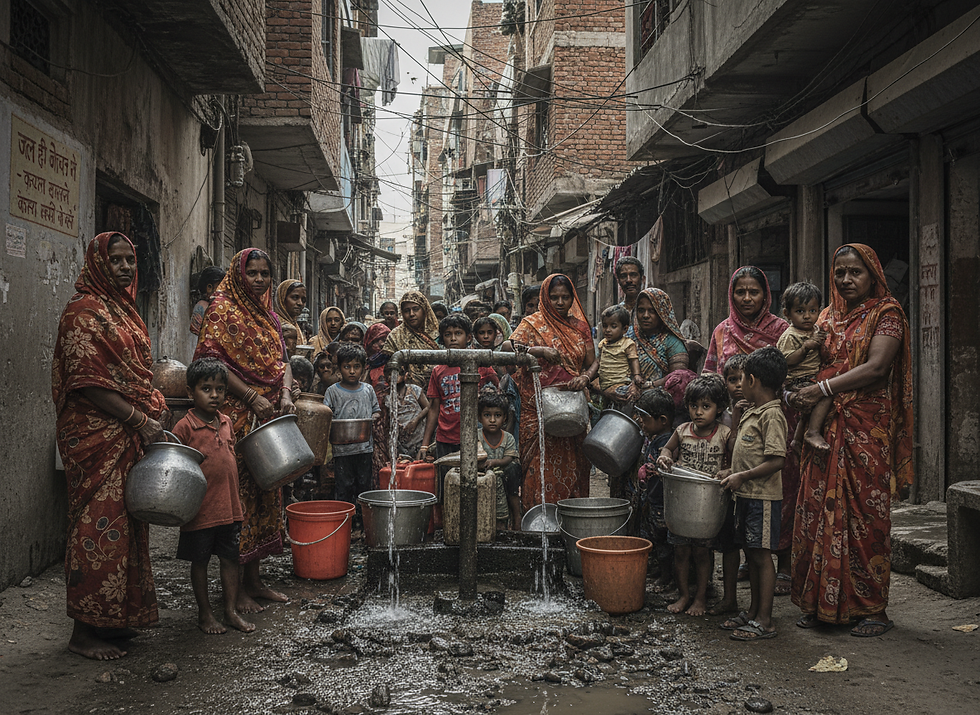
The National Green Tribunal (NGT) subsequently described the incident as a “serious governance failure,” stressing that compensatory responses cannot replace proactive governance. Delhi: A Gradual Catastrophe in the Capital. While Indore faced a sudden disaster, Delhi has experienced a drawn-out and covert crisis. Under Chief Minister Rekha Gupta, the capital is perilously close to a large-scale contamination event. In neighbourhoods such as Kunwar Singh Colony, Anand Vihar, Model Town, and Karol Bagh, residents have been enduring water that is mixed with sewage and carries a foul odour for several months. Data from the Delhi Jal Board (DJB) indicates close to 45,000 complaints regarding contamination during the nine months, a shocking statistic that contradicts the assertions of safety made by officials. However, significant measures were only initiated after scrutiny by the Delhi High Court and ongoing media pressure. Even then, the measures have been inconsistent: temporary flushing of pipelines, varying advisories, and delays in repairs, all lacking a clear accountability framework. Critics assert that Chief Minister Rekha Gupta’s administration has persistently minimised the gravity of the situation, declining to label it a public health crisis or to conduct an independent audit across the city. This hesitance is particularly troubling, considering that about 18% of Delhi’s 15,600 kilometres of pipeline are over 30 years old, with some segments going back to the 1970s. The age of the pipelines, deteriorated joints, and their nearness to sewage lines make the occurrence of contamination not a rarity but a certainty. Trust in public services has further diminished upon discovering that 25 DJB water testing facilities lack NABL accreditation. This casts doubt on the validity of official "safe for consumption" certificates, making them scientifically questionable and legally precarious. Despite this, senior officials at DJB have not faced any disciplinary actions, nor have there been any criminal investigations initiated, raising concerns that administrative silence is preferred over fulfilling constitutional responsibilities. Gandhinagar and the Illusion of New Infrastructure
The issue is not limited to older cities or outdated infrastructure. Gandhinagar, Gujarat’s designed capital, offers a concerning alternative perspective. On January 4, 2026, over 150 children suffered from a typhoid outbreak linked to a newly installed drinking water pipeline. Under Chief Minister Bhupendra Patel, this incident revealed serious gaps in contractor management and quality control. The occurrence of contamination in a newly constructed pipeline challenges the idea that merely expanding infrastructure guarantees safety. Initial assessments indicate the use of inferior materials and inadequate sealing problems that suggest systemic corruption and regulatory negligence. The National Human Rights Commission (NHRC) has since demanded explanations from state officials, indicating that even "model cities" are vulnerable. A Biological and Medical Emergency
Healthcare professionals have cautioned that India is confronting a biological crisis, rather than just an infrastructural one. Dr Siddharth Srivastava from GB Pant Hospital mentions that patients are arriving with severe ailments: septic shock, kidney failure, and multi-organ dysfunction. These cases go beyond typical waterborne diseases normally seen during monsoon seasons; they indicate prolonged exposure to extremely contaminated water.
Researchers from the National Environmental Engineering Research Institute (NEERI) have consistently emphasised that when drinking water pipelines are positioned alongside sewage lines, often under lower pressure, contamination cannot be avoided. Issues like corrosion, drops in pressure, and illicit connections worsen the situation. These findings have been recorded for years, yet there is little evidence of corrective actions being taken.

Policy Promises vs. Ground Reality: The government often points to flagship initiatives like Jal Jeevan Mission (Urban) and AMRUT 2.0, with a combined funding exceeding ₹67,000 crore, as proof of its dedication. However, audit evaluations reveal a considerably different reality. Only approximately 10% of the surveyed cities consistently deliver water that adheres to safety standards. In Delhi, resources have frequently been redirected towards superficial enhancements, new tanks, digital meters, and promotional campaigns while subterranean pipelines keep deteriorating. In Indore and Gandhinagar, contractors associated with the “Har Ghar Jal” programs are being investigated for supposedly employing low-quality materials that hasten corrosion and permit sewage leakage. The trend is evident: spending on infrastructure without reforms in institutions simply repackages previous failures. Judicial Intervention and the Limits of the Courts
Courts have increasingly intervened where executive actions have fallen short. The Madhya Pradesh High Court labelled the situation in Indore as a “public health crisis,” warning of civil and criminal repercussions for careless officials. The NGT has sent urgent notifications to several state governments, while the NHRC has raised concerns regarding the installation of pipelines beneath toilets and sewage areas.
However, judicial action, though necessary, is fundamentally a response to issues. Courts can order investigations and compensation, but they cannot substitute for a functional governance system. Dependence on legal action as the main means of accountability highlights administrative stagnation.
Public Resistance and the Rise of a Jan Andolan
Public frustration has now crystallised into a widespread Jan Andolan. Demonstrators in various cities have congregated outside municipal offices and water agencies, displaying bottles filled with black, polluted water as proof of government failure. Social media activism, citizen-led water testing initiatives, and independent journalism have all challenged official claims and compelled reluctant authorities into the spotlight.
The demands are clear-cut: initiation of criminal cases for culpable homicide against negligent officials, immediate segregation of sewage and drinking water lines, transparent audits by third-party entities of all testing labs, and timely replacement of outdated pipelines.
Conclusion:
Water, Accountability, and the Constitution. India’s urban water dilemma is not merely an issue of technical mishaps; it is a gradual violation of constitutional rights. When citizens have to choose between quenching their thirst and risking disease, the pledge of Article 21 is fundamentally broken. Compensation after loss of life cannot bring back the deceased, nor can disciplinary measures change years of oversight. Access to safe drinking water should be prioritised as an unassailable public health concern, shielded from political cycles and bureaucratic delays. This necessitates not only financial resources but also unwavering accountability, refined municipal governance, and independent supervision. If this crisis continues to be downplayed, India faces the danger of normalising avoidable fatalities as

collateral damage in urban development. The Constitution mandates improved conditions. The public is calling for change. The pressing question remains whether those in authority are prepared to take action before tainted water results in further tragedies.


Comments